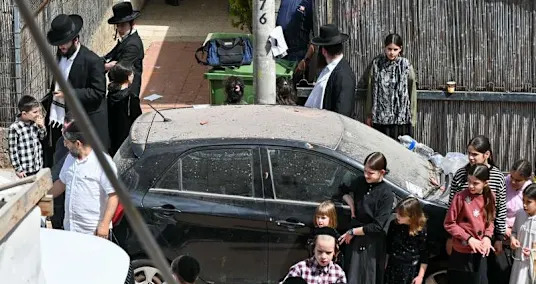
Iran and its Lebanese Hezbollah militia proxy on Thursday fired rockets again at Israel, where people are currently celebrating Passover.
In the morning, warning sirens sounded repeatedly in northern Israel. Two men were slightly injured by a Hezbollah rocket, the Magen David Adom emergency service said.
An Iranian rocket also aimed at the north was fitted with cluster munitions, Israeli media reported. The use of cluster munitions is widely banned internationally because they can scatter explosive devices uncontrollably over large areas and are particularly dangerous for civilians.
There was also repeated fire at Israel overnight. A rocket alert was triggered in the coastal metropolis of Tel Aviv, among other places. Magen David Adom reported several people with minor injuries from broken glass in a suburb of Tel Aviv, including two babies.
The week-long Passover festival began on Wednesday evening for Jews around the world. It commemorates the exodus of the Israelites from Egypt and their liberation from slavery.
latest_posts



 I watched more than 500 new movies this year. These are the 25 best ones.
- 4K televisions for Extreme Film Watching Experience
- What is ‘Auld Lang Syne’? Why we sing this song at midnight on New Year’s Eve.
- The most effective method to Safeguard Your Teeth from Acidic Food varieties and Beverages
- What an expert on the gut microbiome eats in a day
- The Most Paramount Crossroads in Olympic History
- Vote In favor of Your Favored Occasion Arranging Administration
- Astronaut on ISS captures spectacular orbital video of zodiacal light, auroras and the Pleiades
- Pick the Ideal Family Feline Variety for Your Home